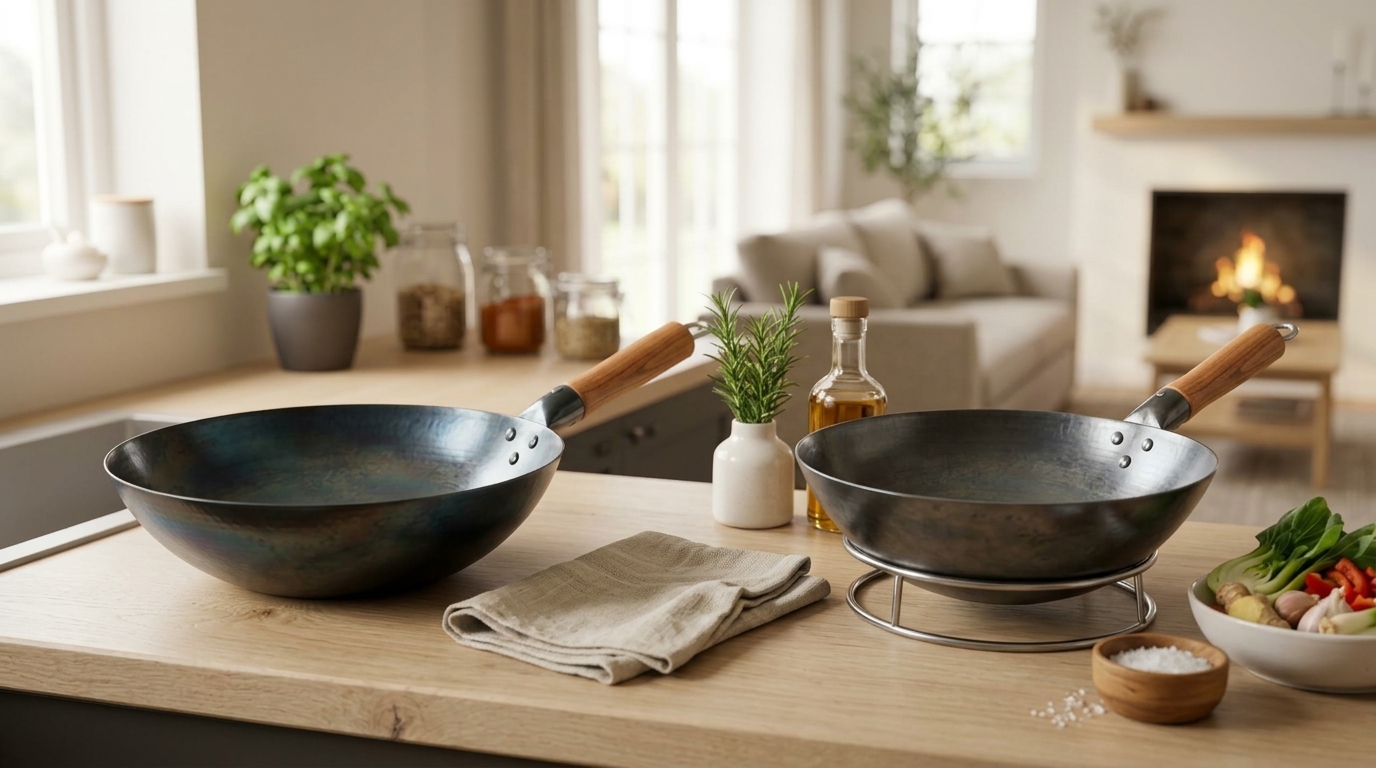
Quick Verdict: Flat Bottom vs Round Bottom Woks
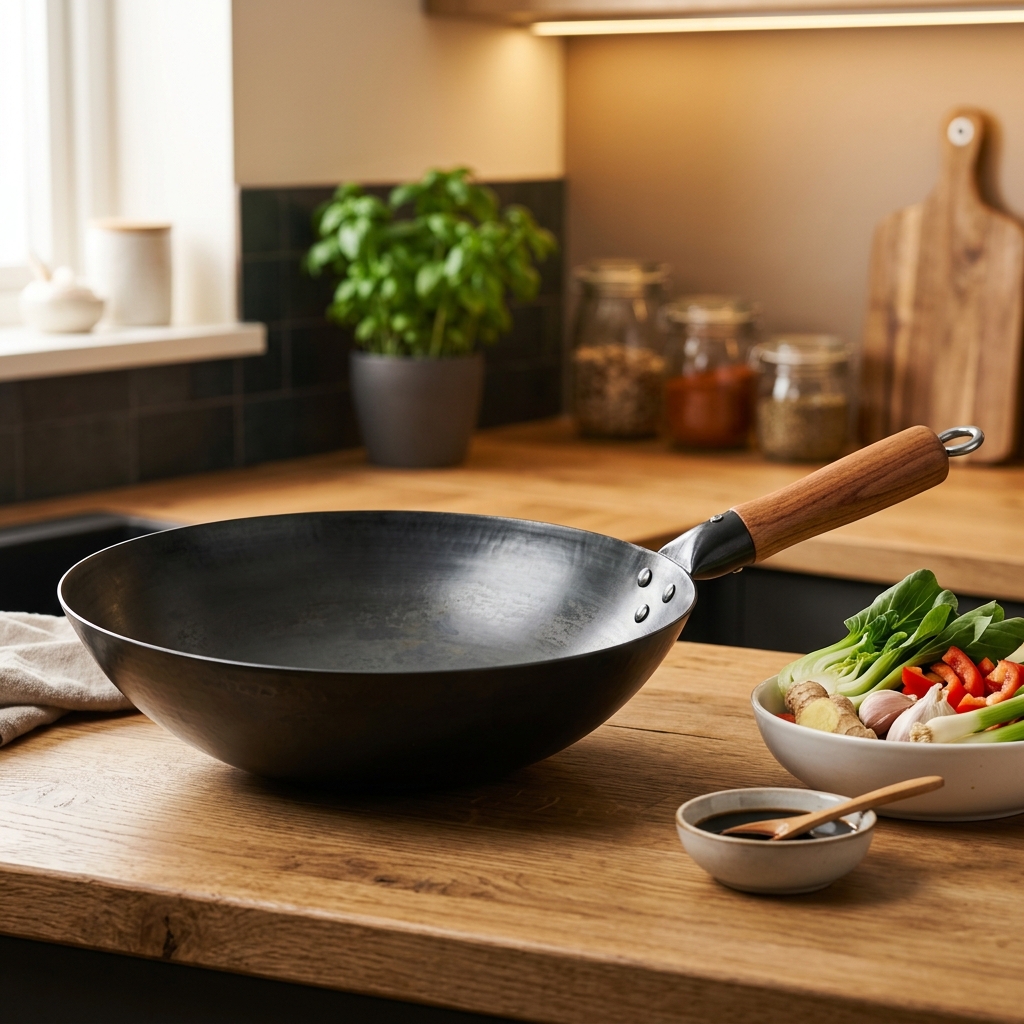
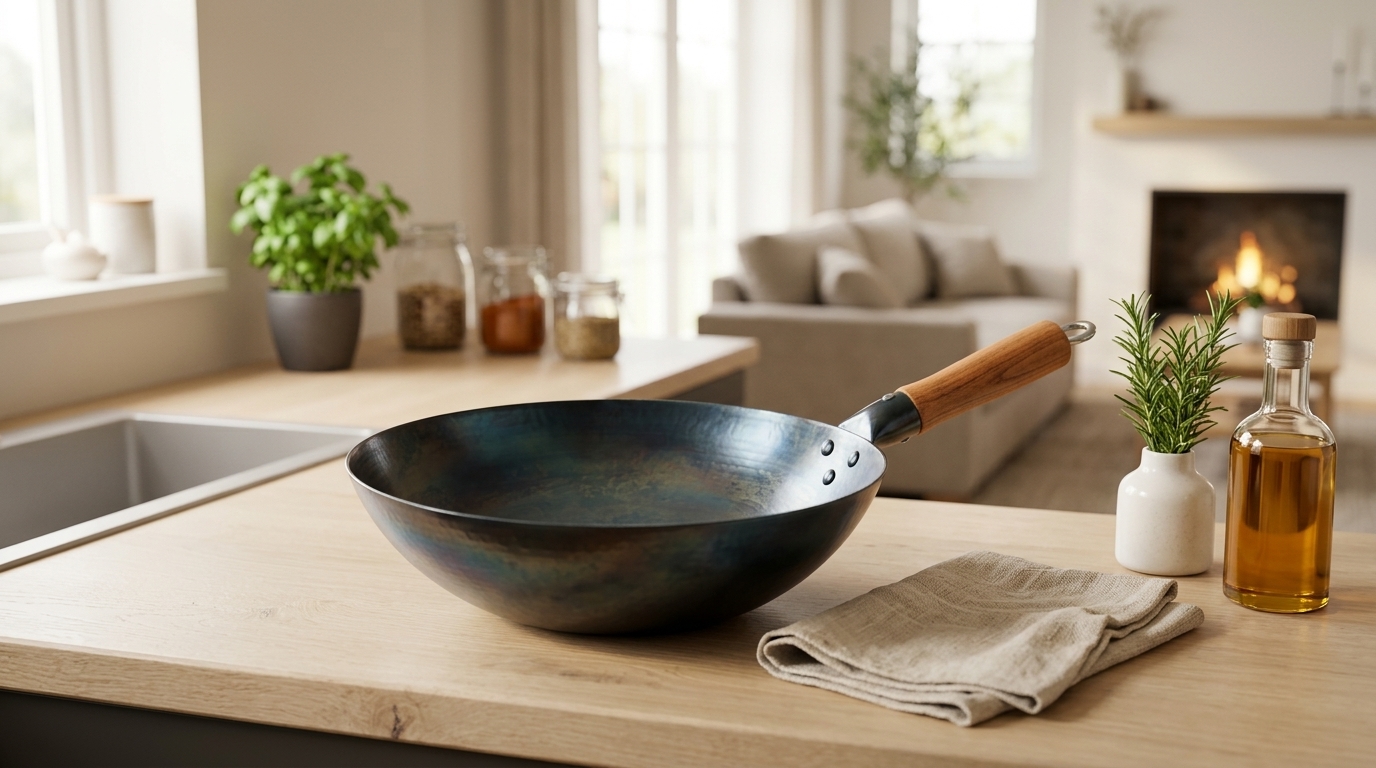
Flat-bottom carbon steel woks are essential for American induction, glass-top, and electric coil stoves because they maximize direct surface contact for rapid heat transfer. Round-bottom woks require high-BTU open gas flames and wok rings, which cause severe heat loss and sensor shutoffs on flat induction glass.
Stovetop Physics: Direct Contact vs Wok Ring Heat Loss
Heat transfer efficiency on electric and induction cooktops depends entirely on continuous physical contact between the pan base and the glass surface.
A flat-bottom wok provides a 5 to 6-inch direct contact zone that absorbs concentrated heat and radiates it smoothly up the flared curved sides.
Round-bottom woks balance on a small central tangent point, requiring an external metal wok ring for mechanical stability.
Elevating a round wok inside a ring creates a 1 to 2-inch air gap that prevents electromagnetic induction coupling and loses up to 60% of radiant electric heat.
For testing data on electromagnetic base efficiency, explore our Induction Safe Ceramic Cookware Guide.
Induction Performance: Why Carbon Steel Excels on Magnetic Burners
Carbon steel is naturally ferromagnetic, making flat-bottom woks among the most responsive pans available for modern induction burners.
Unlike multi-ply aluminum pans that require bonded steel plates, solid 1.5mm carbon steel converts 90% of electromagnetic field energy directly into thermal heat.
On a standard 1800W induction element, a flat-bottom carbon steel wok reaches 450°F stir-fry searing temperatures in under 90 seconds.
Because the flat base sits flush against the cooktop, induction safety sensors register the pan immediately without clicking or buzzing.
To learn how to blue and season a new carbon steel pan properly, follow our Non-Toxic Carbon Steel Wok Seasoning Guide.
Culinary Mechanics: Tossing, Searing & Heat Zone Control
While round-bottom woks offer a continuous seamless curve for effortless spatula scooping on gas flames, modern flat-bottom woks are engineered with gentle transitions.
The flat center creates a dedicated high-heat searing zone for caramelizing proteins, while the sloping walls allow delicate greens to steam and rest away from intense heat.
Using a wooden helper handle allows easy two-handed tossing without scratching delicate ceramic glass cooktops.
Pairing high heat with natural high-smoke point oils produces authentic restaurant-style wok hei flavor without synthetic chemical nonstick coatings.
For non-toxic oil smoke point breakdowns, check our PTFE vs Ceramic Off-Gassing Audit.
Cooktop Care: Preventing Scratches and Thermal Shock on Glass
Heavy cookware moved aggressively across ceramic glass can cause micro-scratches if the pan bottom has rough manufacturing burrs.
Always inspect the flat bottom of a new carbon steel wok and gently smooth any stamping edges with fine steel wool before initial kitchen use.
Lift the wok vertically when tossing ingredients rather than sliding the base back and forth across induction glass.
Never place a scorching hot wok directly into a cold sink, which can cause thermal shock and warp the flat base.
For modular kitchen pans with smooth base plates, review our Space Saving Cookware Sets Guide.
Who Is This NOT For?
Flat-bottom carbon steel woks are not necessary for cooks who already have professional 25,000+ BTU outdoor wok burners designed specifically for round-bottom pans.
They are also not ideal for cooks who want dishwasher-safe convenience; for dishwasher-safe sets, explore our CAROTE vs GreenPan Comparison and CAROTE vs Sensarte Comparison.
Cooks looking for heavy thermal braising rather than rapid flash frying should consider enameled iron; see our Heirloom Carbon Steel Guide.
For chemical safety across mineral nonstick options, review Is Granite Cookware Safe?.
The Buying Verdict: The Best Flat-Bottom Wok for Modern Stoves
Yosukata 14-Inch Pre-Seasoned Flat-Bottom Wok is the clear winner for home cooks on induction and electric stoves, delivering optimal magnetic contact and heavy-duty stability.
If you cook exclusively on a commercial gas flame, traditional round-bottom woks remain an authentic heritage choice.
For standard home kitchens, a quality flat-bottom carbon steel wok provides the ultimate balance of heat speed, non-toxic safety, and culinary versatility.
Expert Answers & Material Science Q&A
Can you use a round-bottom wok on a flat glass induction stove?
No. Round-bottom woks do not make sufficient contact with induction glass and will trigger cooktop error codes or heat unevenly.
Does a flat bottom affect authentic wok hei flavor?
Not significantly. High heat and rapid tossing across the sloping sides create authentic wok hei, and flat bases ensure maximum heat transfer on electric stoves.
What thickness is best for a flat-bottom carbon steel wok?
A thickness of 1.5mm to 1.8mm is ideal. It provides enough thermal mass to prevent warping while remaining light enough for single-handed tossing.
Will a carbon steel wok scratch my induction cooktop?
Flat-bottom carbon steel woks are safe for induction glass when lifted vertically during tossing and kept free of rough metal burrs on the base.